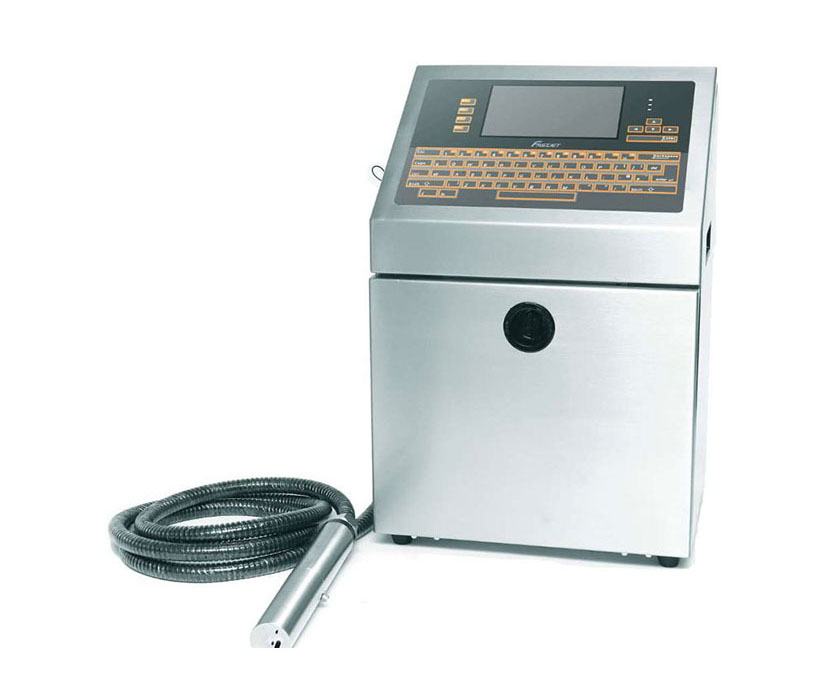
The reason why a good product can be popular in the market is not only because of its excellent quality, but also because of an eye-catching and just right packaging appearance. The most direct sensory experience is the pattern and product details on the outer packaging. How to efficiently print the details on the product outer packaging or packaging cardboard box? The inkjet printer emerged as a result.
Nowadays, many fully automatic packaging conveyor lines have the presence of inkjet printers, which usually appear in the later stage of packaging weighing and inspection of qualified products. A coding machine is a device controlled by software that uses non-contact methods to identify products. Generally refers to Continuous Inkjet Printer, abbreviated as CIJ. The theory of inkjet printers was invented in the late 1960s, and it was not until the late 1970s that the world's first commercial inkjet printer was produced. There are many types of inkjet printers, including small character inkjet printers, large character inkjet printers, high-resolution inkjet printers, laser inkjet printers, UV inkjet printers, etc. With the improvement of people's awareness of identification, the application scope of inkjet printers is becoming wider and wider. They have become an indispensable equipment in the production industries of electronics, medicine, stationery, food, building materials, etc. Although there are many types on the market, their core working principle is generally to use ink charged displacement to deflect the ink out of the normal circulation path. The ink is directly directed towards the surface of the workpiece, and the position of each ink droplet is controlled by logic. Usually, ink droplets only change vertically. As they are ejected ink, they do not need to directly contact the surface of the workpiece, and the data we want to print can only be formed through the movement of the workpiece. We just need to understand it as a skilled master painting, which may seem simple, but it is indeed a delicate task.